
Check the link for up to date info : Updated 13 Jan
https://www.bbc.co.uk/news/explainers-54239922
People with Covid in England will be able to end self-isolation after five full days, Health Secretary Sajid Javid has said.
Across the UK, the self-isolation period had already been reduced to seven full days, but it is not clear whether all nations will implement the latest reduction.
What are the new self-isolation rules for people with Covid in England?
Anyone who develops symptoms or tests positive for Covid must immediately self-isolate.
From Monday 17 January, people who test positive will be able to leave self-isolation after a further five full days, subject to having two negative LFT results, 24 hours apart.
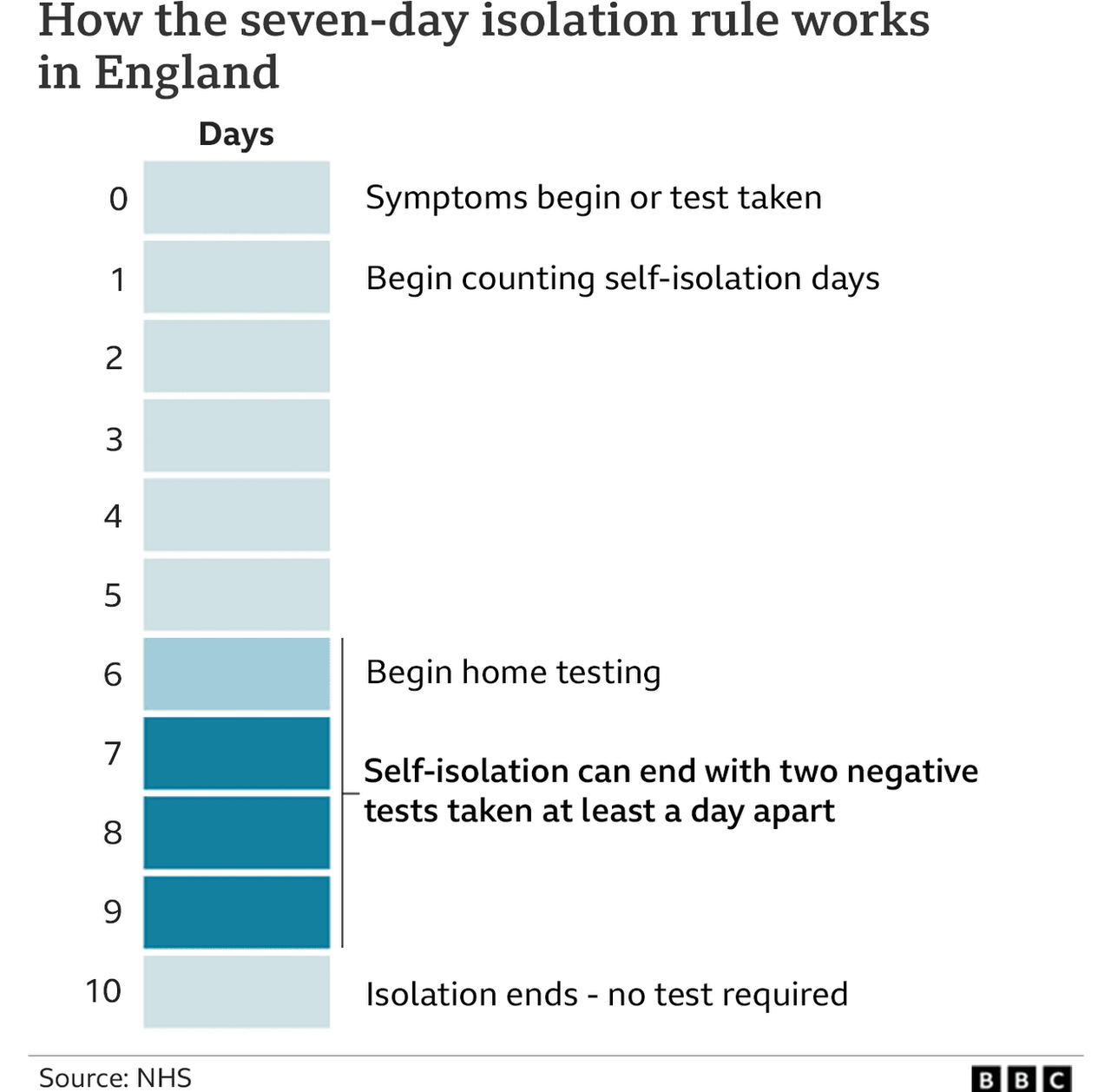
The day symptoms begin or you test positive is day zero. The next day is day one of your isolation period.
You can take your first test on day five. If it is negative, you can take another test 24 hours later on day six. Assuming this is also negative - and you do not have a temperature - you can immediately leave isolation.
The rules apply whether you are vaccinated or not.
Health Secretary Sajid Javid said the change would "maximise activity in the economy and education" while also minimising the risk of infection from people leaving isolation.
He told MPs that data from the UK Health Security Agency shows about two-thirds of positive cases are no longer infectious by the end of day five.
However, the data also shows that the current policy of releasing people on day seven day after two negative tests means about two in five infectious cases are missed. It is not clear what effect this further reduction to the self-isolation period will have.
What are the self-isolation rules for people with Covid across the rest of the UK?
In Scotland, Wales and Northern Ireland (and England until Monday) you must self-isolate for at least seven days as soon as symptoms develop, or - if you have no symptoms - when you test positive.
In addition, people without symptoms who have a positive LFT result no longer have to take a PCR test to confirm their status but should immediately start isolating. Clinically vulnerable people in Wales and Northern Ireland are still advised to take a PCR.
The new testing guidance will stay in place while Covid case levels remain high, because the vast majority of people with positive LFT results at the moment are extremely likely to have coronavirus.
Whichever type of positive test result you had, you can end self-isolation after two negative LFT results, 24 hours apart - the first no earlier than day six. As long as you do not have a high temperature, you can stop self-isolating after the second negative test, on day seven.
If the day-six test is positive, you can take two further tests on subsequent days, and - as long as you don't have a fever - you can stop isolating once you have had two negative results, 24 hours apart.
The guidance applies whatever your vaccination status, or whichever Covid variant you have.
However, anyone leaving self-isolation after seven days is "strongly advised" to limit close contact with people in crowded or poorly ventilated spaces.
They should work from home and minimise contact with anyone who is at higher risk of severe illness.
How do I get a lateral flow or PCR Covid test? https://www.bbc.co.uk/news/health-51943612
What are the self-isolation rules for contacts of people with Covid?
The rules about self-isolation after contact with a positive case are broadly similar across the UK.
If you are fully vaccinated (two doses - three in Scotland), you do not have to self-isolate, but should take daily LFTs for seven days (or until 10 days since your last contact, if this is earlier).
This also applies to people under the age of 18 (18 years and four months in Scotland; 18 years and six months in England).
If any of the LFTs are positive, you'll need to self-isolate from the date of the test but no longer need to take a PCR test to confirm the result.
Close contacts of positive cases who are not fully vaccinated still have to self-isolate for the full 10 days. In Scotland, they are advised to take one PCR test and continue isolating even if the result is negative.
In Wales, unvaccinated contacts are advised to take LFTs on days two and eight, even if they have no symptoms.
Anyone who develops Covid symptoms during self-isolation should take a PCR test.
Self-isolation rules in England : https://www.gov.uk/government/publicati ... -infection
Self-isolation rules in Scotland : https://www.nhsinform.scot/illnesses-an ... -infection
Self-isolation rules in Wales : https://gov.wales/self-isolation
Self-isolation rules in Northern Ireland : https://www.nidirect.gov.uk/articles/co ... e-contacts
What does self-isolation mean?
Self-isolation means staying at home and not going out.
Adults shouldn't go into work and children shouldn't go to school.
You should order online groceries, or ask friends or family to deliver supplies.
No-one from outside your household should come inside, unless to deliver essential care.
If you have symptoms or test positive, you should:
Keep your distance from other members of your household
Leave windows open to improve ventilation
If possible, sleep and eat in a different room, and use a separate bathroom
If you share a bathroom, use it after everyone else and clean it thoroughly
If you do not follow the rules on self-isolation, you can be fined. In England, penalties start at £1,000 and rise to £10,000.
People on a low income who are told to isolate by one of the UK's tracing services may be entitled to some financial help:
a £500 test and trace payment in England : https://www.gov.uk/government/publicati ... ent-scheme
a £500 self-isolation support grant in Scotland : https://www.mygov.scot/self-isolation-grant
a £750 self-isolation support scheme payment in Wales : https://gov.wales/self-isolation-support-scheme
a discretionary support self-isolation grant in Northern Ireland : https://www.nidirect.gov.uk/articles/ex ... port#toc-4


 So covid does not exist after Thursday?? first time with covid and feel obliged to go in even if i’m Still coughing and sneezing with a positive test... thanks boris ..just taken another test positive got a day to get rid or have 2 separate sicknesses