Covid: Who has to self-isolate and what if I'm fully vaccinated?
Many Covid restrictions have been eased in England and Scotland.
Rules on self-isolation are also changing - although some of them won't happen for a few weeks.
When do I need to self-isolate?
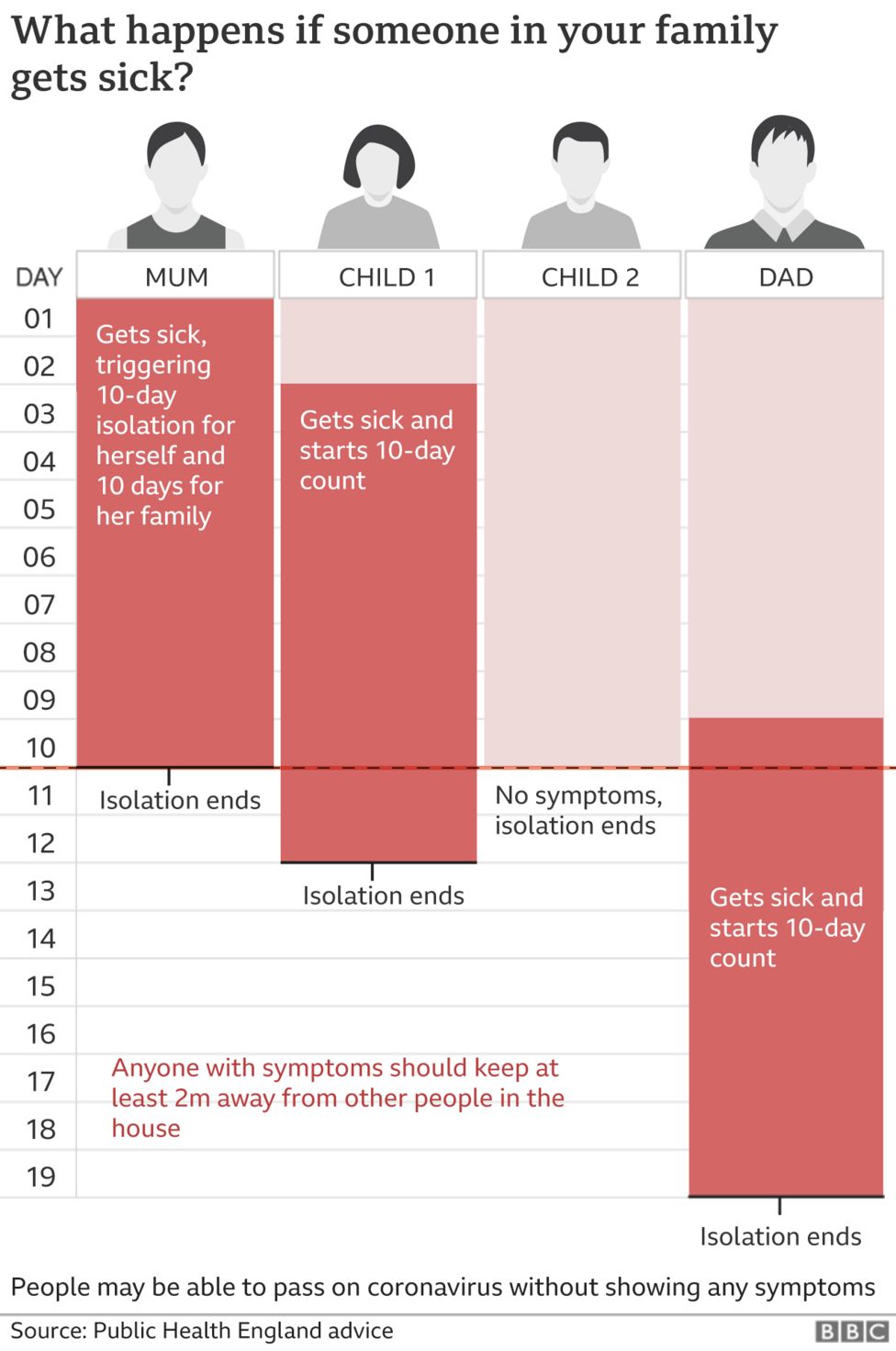
You must self-isolate for 10 days if:
- You have Covid symptoms
You test positive for Covid-19
You live with someone who tests positive
You live with someone who has Covid symptoms (unless they have a negative test)
You are told to isolate by NHS Test and Trace, Test and Protect in Scotland, Test, Trace Protect in Wales or Northern Ireland's Contact Tracing Service
You arrive in the UK from a red list country
You arrive in the UK from an amber list country (fully vaccinated people and under-18s exempt - but not if arriving from France)
Until 16 August in England: You are notified by school that you have been in contact with a case
Do key workers need to self-isolate?
Some fully vaccinated critical workers in England - including health and care staff - will be able to leave leave isolation to go to work, even if they are traced as a contact of someone with Covid.
Letters will be sent to those who are eligible.
Vaccines minister Nadhim Zahawi told the Commons the "very, very small number of named critical workers" would include some air traffic controllers and rail signallers.
At a news conference shortly afterwards, Prime Minister Boris Johnson said he wanted to protect staffing for crucial services, including:
- hospitals and care homes
supplies of food, water and electricity
supplies of medicines
the running of trains
border protection
"defence of our realm"
Even if you have had both jabs you must currently follow the same rules as other people.
However, from 16 August in England, if you are fully vaccinated (double jabbed, plus two weeks), you will no longer have to self-isolate if a close contact tests positive.
If you are identified by NHS Test and Trace, you will be asked if you are fully vaccinated. If so, you will be advised to take one PCR test to make sure you haven't been infected.
If you test positive, you will still need to self-isolate, just like anyone else.
Similar rules are due to come into force in Scotland from 9 August - and in Wales from 7 August.
What self-isolation rules are changing for children?
From 16 August in England, under-18s will no longer have to self-isolate if a close contact tests positive.
Instead, they will be advised to take a PCR test and only have to self-isolate if it comes back positive, or they go on to develop symptoms.
It's hoped this will stop entire classes or year-group bubbles have to self-isolate after one pupil tests positive.
When will self-isolation rules for schoolchildren end?
In Scotland, the government is considering removing self-isolation for pupils in contact with positive cases.
How are the self-isolation travel rules changing?
All adults fully vaccinated by the NHS (and under-18s) no longer have to self-isolate after returning from an amber list country - except if they are arriving from France.
Vaccinated passengers need to prove their status via the NHS Covid Pass in England or equivalent schemes.
What happens if I'm 'pinged' by the app? https://www.bbc.co.uk/news/explainers-52442754
I'm fully vaccinated, but how can I prove it? https://www.bbc.co.uk/news/explainers-55718553
What does self-isolation mean?
Self-isolation means staying at home and not going out for any reason, not even to buy food or medicine.
You should order online groceries, or ask friends or family to help.
No one from outside your household should come inside, unless a family member receives essential care at home.
If you test positive and feel fine, but subsequently develop symptoms, you must restart your 10-day isolation.
If you have symptoms or have tested positive, you should:
Keep your distance from other members of your household
Leave windows open to improve ventilation
If possible, sleep and eat in a different room, and use a separate bathroom
If you share a bathroom, use it after everyone else and clean it thoroughly