The Future of the Post Office Network and the Problem with PO Local.
The Government, Post Office Limited (POL) and the National Federation of Subpostmasters(NFSP) have announced a plan to change the shape of the network of sub post offices over the life of this parliament. The Government has authorised a funding package of £1.34 billion, some of which will be used to finance the proposed changes.
Running in parallel with this network change program will be the introduction of the Postal Services Bill(PSB) which will separate POL from its present ownership by Royal Mail Group(RMG) and place POL in a position where it can apply to become a mutual organisation at a later date.
The Network Transformation Program
This is a new project that aims to deliver the cost savings necessary for POL to become profitable. In broad terms, it seeks to regroup the present 11,500 strong network of post offices into three main groupings, Main, PO Locals and PO Basic.
Eventually there will be approximately 4000 Main Post Offices where all products offered by POL will be on sale. 6000 PO Locals will operate out of Convenience Stores or local businesses such as Pharmacies or Petrol Stations, with a smaller range of products and the remainder will offer limited PO services from a small terminal alongside the retail counter in small shops, pubs etc.
The PO Local model has been in a protracted pilot program for over 12 months now, and is due to be rolled out into a further 2000 locations over the next 3 years.
PO Local
Of the three groupings, it is the PO Local model that is causing the most concern amongst subpostmasters and consumer groups. Interestingly the NFSP maintain that their members support this change program, but they have not consulted their membership directly to see if that is true. However in a recent study by the Communications Workers Union(CWU) who are seeking to stop the Postal Service Bill going through parliament, a vast percentage of subpostmasters polled revealed that they were not in favour of PO Local and that it would lead to them losing their business.
So what is PO Local and what does it replace?
Traditional post offices are operated by a sub-postmaster(SPM), as an agent of POL. SPMs are paid a set monthly fee called a Core payment or in smaller offices an Assisted Office Payment(AOP) as well as a proportion of the sales they generate which is called Transaction Related Pay(TRP).
These post offices by and large have a small retail operation as well, most often greeting cards and stationery, to supplement their income. It is probably fair to say that nowadays with falling income from the Post Office side, most of these smaller offices could not survive without this additional income from retail, or indeed afford to stay open for contracted hours. So in a sense the SPMs retail side is supporting POL.
The properties these Post Offices occupy are either owned by the SPM or leased by the SPM, in some cases from Royal Mail Group. Where these Post Offices are located in towns and villages they generally occupy a prominent position in the main street.
The network transformation program envisages replacing these traditional post offices, by relocating them within a local Convenience Store or other outlet that has longer opening hours. This will provide the Convenience store operator with the advantage of an additional revenue stream plus increased footfall. The PO Customer will have the advantage of longer Post Office opening hours as these will be generally the same opening hours of the convenience store. POL will gain financially as the convenience store operator will not be paid Core or AOP (this is however under review but if they do receive a fixed element it will be substantially less than existing payments to Subpostmasters).
The PO Local model sees a change to the traditional glass screen fortress design to an open plan PO counter located alongside the retail counter. This allows convenience store employees to serve both retail and PO customers simultaneously.
It all sounds to good to be true. The customer benefits, POL benefits and the convenience store operator benefits. But is it?
Well there are going to be a few losers as well. The original intention of PO Local was to have them provide only a basic set of PO Products. For the more complicated products such as Travel products and Motor Vehicle Licencing(MVL) customers were going to have to travel to their nearest Main Post Office which could be in the next town many miles away. Scrutiny of the Pilot sites has lead to a bigger range of products being available but that leads to more problems which will be discussed later.
If customers are faced with travelling to a larger shopping centre to carry out Post Office transactions it is reasonable to expect that they will take their other shopping requirements with them as well, so local businesses will inevitably suffer, including of course the convenience store that has taken on the Post Office Local.
As stated previously, current Post Offices are traditionally sited in prominent positions in the High Street. Given the current difficulties in High Street trading, the loss of such a business will be almost impossible to replace and should neighbouring businesses close as result of the PO closing(as seen in previous PO closure programs), the average High Street could see many more vacant shops.
The customer experience in a PO Local will be significantly changed. PO customers will compete with retail customers for attention. The social aspect of help, advice and a chat will be lost. Queues in busy times will be complex to say the least as the retail operator has to decide whether to have a single queue for both retail and PO or two separate ones. If he chooses two queues, which is the more profitable queue to serve first? Inevitably the retail side will have priority. Will the retail customer be patient as the elderly take a while getting their pension and making their rent payments?
It is not all a bed of roses for the convenience store operator either. The range of PO products he will now have to offer has increased from the originally proposed list of straightforward products to the more complex ones such as business banking and Car Tax. To sell these, requires skilled and trained staff who would expect to receive a higher wage than normal retail staff. Staff costs start to become unrealistic as higher paid staff will be needed during the less busy periods solely to service the PO counter. Staff would also have to be trained at offsite locations at the operators expense.
And of course the customer experience in Main Post Offices is about to become a lot worse. If there is anything uniquely traditional about a large UK Post Office it is the common experience of long queues, now made longer by the arrival of customers previously served by High Street Post Offices. Main Post Offices will also have to provide new government services when they arrive and current indications are that these services will be even more time consuming. In addition to this POL is focusing a great deal of effort on increasing financial product sales in their Main PO outlets, which in turn requires extra sales conversations with PO customers leading to even longer delays in getting served.
While there is some promise of compensation to present Sub postmasters who lose their business to a PO Local, these people will be the biggest losers financially. Compensation is only a cheque on which tax is payable and out of which redundancy payments have to be made to long serving staff. Rates will have to continue to be paid on premises and lease agreements will have to be bought out. What is left will not be enough to finance a replacement business as borrowing to purchase a small business these days is extremely difficult if not impossible without a significant deposit.
PO Local is also a terminal proposition. Possibly the one thing that has really been overlooked and cannot be quantified until it actually happens, is the impact that failure of a PO Local will have. To take on a PO Local requires the Convenience Store operator to make a significant investment. Should the operator at a later stage realise that the return on his investment is not sufficient and that he would be better off returning the space allocated to POL on his shop floor to retail then all he has to do is tell POL to remove their equipment. Where then does the next PO Local spring up? Which other local retailer would make the same expensive commitment to POL without first finding out why the previous PO Local had failed? In these circumstances what is Plan B? There isn't one other than provision of PO services to that area by an outreach service. And of course the impact of the closure of the original PO on the High Street remains forever.
In Conclusion.
It is perfectly understandable why the management of Post Office Ltd, the Government, the convenience store operator and possibly the consumer could be convinced that PO Local is the way forward. From many perspectives it seem a clever strategy that could lead to the Post Office Network becoming profitable and sustainable. However every plan has its risks and rewards and before proceeding these must be detailed. All risks need to be assessed and plans put in place to mitigate failure. There are no such plans in place. Failure of this transformation program in the longer term could result in the collapse of the Post Office Network to a point where only the Main and Basic outlets survive.
But crucially, whether this program succeeds or fails the traditional post office will be gone forever.
ANNOUNCEMENT : ALL OF ROYAL MAIL'S EMPLOYMENT POLICIES (AGREEMENTS) AT A GLANCE (Updated 2021)... HERE
ANNOUNCEMENT : PLEASE BE AWARE WE ARE NOT ON FACEBOOK AT ALL!
The problem with PO Local
-
obiwanknobe
- POST OFFICE
- Posts: 58
- Joined: 10 Feb 2011, 11:05
- Gender: Male
-
subbie
- POST OFFICE
- Posts: 418
- Joined: 03 Feb 2010, 11:41
- Gender: Male
Re: The problem with PO Local
All this, so the Government can save a miserly £180m per annum, cos that is what is at the bottom of all this, championed by Lib Dems as well, shame on them, another election pledge bites the dust.
Subbie
Subbie
-
obiwanknobe
- POST OFFICE
- Posts: 58
- Joined: 10 Feb 2011, 11:05
- Gender: Male
Re: The problem with PO Local
Sorry but no. Even after this the Government will be committed to providing POL with £180m per year. Unfortunately they didn't think through their justification document to the EU for state aid. To keep 11500 post offices open in any shape or form they require to pay POL £180m per year. Which, according to HM, is not even sufficient to meet the losses sustained.
-
subbie
- POST OFFICE
- Posts: 418
- Joined: 03 Feb 2010, 11:41
- Gender: Male
Re: The problem with PO Local
Sorry to disagree Obi, the BIS Policy document clearly states that POL should drastically reduce its reliance on the £180m annual payment, to the degree where it should only need a small amount, they have until the end of this Parliament to achieve this. Clearly the £180m is spent on the fixed element of Sub PO's pay, and on Crowns I wouldn't mind betting, so if POL are to see the £180m shrink annually, then their way forward is to introduce a lower cost model of PO eg PO Local,
The first tranche of £180m has been cleared by Europe, but it is only for one year, I wonder how much the next application will be for?
The Gov are getting away with cutting this payment, and in doing so will change the face of the PO Network for ever. And not for the better in my opinion.
Subbie
The first tranche of £180m has been cleared by Europe, but it is only for one year, I wonder how much the next application will be for?
The Gov are getting away with cutting this payment, and in doing so will change the face of the PO Network for ever. And not for the better in my opinion.
Subbie
-
obiwanknobe
- POST OFFICE
- Posts: 58
- Joined: 10 Feb 2011, 11:05
- Gender: Male
Re: The problem with PO Local
This is a very difficult subject to understand.
The government pays the state aid to POL for delivery of SGEI (services of general economic interest).
In order to supply SGEI, POL undertakes to deliver minimum access requirements to Post Offices.
It is the cost of doing so that results in the state aid being required. For the last few years at least POL have declared that the State Aid has been fully utilised and it has cost more to deliver SGEI.
So it is a bit of a Catch 22 situation. The government wants to reduce state aid to POL but cannot do so while it maintains an 11500 network which is government policy.
In addition it is the governments declared intention to provide more SGEI work through the post office network.
It is also the government's intention to mutualise POL. SGEI will always cost money to deliver so why would a mutual POL wish to finance SGEI out of its own profits which would be attributable to its members and not HMG?
However the BIS document acknowledges that subsidy will continue to be required after network transformation and POL acknowledge that less will be required.
Clear as mud and most likely not thought through properly.
The government pays the state aid to POL for delivery of SGEI (services of general economic interest).
In order to supply SGEI, POL undertakes to deliver minimum access requirements to Post Offices.
It is the cost of doing so that results in the state aid being required. For the last few years at least POL have declared that the State Aid has been fully utilised and it has cost more to deliver SGEI.
So it is a bit of a Catch 22 situation. The government wants to reduce state aid to POL but cannot do so while it maintains an 11500 network which is government policy.
In addition it is the governments declared intention to provide more SGEI work through the post office network.
It is also the government's intention to mutualise POL. SGEI will always cost money to deliver so why would a mutual POL wish to finance SGEI out of its own profits which would be attributable to its members and not HMG?
However the BIS document acknowledges that subsidy will continue to be required after network transformation and POL acknowledge that less will be required.
Clear as mud and most likely not thought through properly.
-
MinisterofCucumber
- Posts: 806
- Joined: 15 Dec 2009, 22:18
- Gender: Male
Re: The problem with PO Local
I think it has been thought through properly and it is an underhanded strategy to get rid of most of the Post Office network.
The Coalition are even slimier than Mandelson. Politically, they must be seen to be trying to save the network because the voters want it to stay so they have devised a method by which Post Offices can close and the politicians won't get the blame for it.
Anyone not taken in by the marketing bullshit can see that a PO Local is not going to be as good as a traditional Post Office for most customers. The only selling point is the possibility of increased opening hours.
When the PO Locals fail, the politicians will put the blame partly on the retailers but mostly on the customers. They will say, "It's your own fault that you lost your Post Office".
w*****s. (We really need a smilie that makes the 'w****r' sign)
The Coalition are even slimier than Mandelson. Politically, they must be seen to be trying to save the network because the voters want it to stay so they have devised a method by which Post Offices can close and the politicians won't get the blame for it.
Anyone not taken in by the marketing bullshit can see that a PO Local is not going to be as good as a traditional Post Office for most customers. The only selling point is the possibility of increased opening hours.
When the PO Locals fail, the politicians will put the blame partly on the retailers but mostly on the customers. They will say, "It's your own fault that you lost your Post Office".
w*****s. (We really need a smilie that makes the 'w****r' sign)
"You wanna f**k with me? Okay. You wanna play rough? Okay. Say hello to my little friend!" - Tony Montana
-
billyhayes
- POST OFFICE
- Posts: 456
- Joined: 05 Aug 2007, 00:50
- Gender: Female
Re: The problem with PO Local
I second that motion. POSTMAN, over to you...MinisterofCucumber wrote:(We really need a smilie that makes the 'w****r' sign)
-
obiwanknobe
- POST OFFICE
- Posts: 58
- Joined: 10 Feb 2011, 11:05
- Gender: Male
Re: The problem with PO Local
See http://www.royalmailchat.co.uk/communit ... 60#p411424" onclick="window.open(this.href);return false;
-
obiwanknobe
- POST OFFICE
- Posts: 58
- Joined: 10 Feb 2011, 11:05
- Gender: Male
The problem with PO Mains
It now appears that problems have arisen with the proposed trial of PO Mains. Supposedly 4000 of these will be created. Information has come to hand indicating that perhaps not all is that it seems with these creations. 4000 Spms were hopeful of new found wealth if chosen to be one of the illustrious bunch. As it turns out many if not all will be losers when the Core part of their payment is removed and replaced with increased transaction related pay. So much so that POL are now offering £10k up front as a sweetener.
When this new information was published on the NFSP forum they shut it down. Why don;t they want their members to know? What kind of Union is this that betrays its members in this way? Why are they walking hand in hand with POL? The POL forum called Subspaceonline is also removing all references to another forum that has published this information. Censorship will never win.
Obi
When this new information was published on the NFSP forum they shut it down. Why don;t they want their members to know? What kind of Union is this that betrays its members in this way? Why are they walking hand in hand with POL? The POL forum called Subspaceonline is also removing all references to another forum that has published this information. Censorship will never win.
Obi
-
JacksterD
- POST OFFICE
- Posts: 16
- Joined: 13 May 2011, 21:48
- Gender: Male
Re: The problem with PO Mains
What's the Core part of the payment you're talking about? I'm currently working in one of the 11 Main branch trials and the manager's been on and off the phone all week to POL, it sounds like there's something missing from the payment he receives from them and all the staff are on edge regarding the branch's future.obiwanknobe wrote:It now appears that problems have arisen with the proposed trial of PO Mains. Supposedly 4000 of these will be created. Information has come to hand indicating that perhaps not all is that it seems with these creations. 4000 Spms were hopeful of new found wealth if chosen to be one of the illustrious bunch. As it turns out many if not all will be losers when the Core part of their payment is removed and replaced with increased transaction related pay. So much so that POL are now offering £10k up front as a sweetener.
When this new information was published on the NFSP forum they shut it down. Why don;t they want their members to know? What kind of Union is this that betrays its members in this way? Why are they walking hand in hand with POL? The POL forum called Subspaceonline is also removing all references to another forum that has published this information. Censorship will never win.
Obi
Full-time student, part-time sub Post Office counter clerk.
Can be found tweeting at https://twitter.com/#!/JacksterD
Can be found tweeting at https://twitter.com/#!/JacksterD
-
obiwanknobe
- POST OFFICE
- Posts: 58
- Joined: 10 Feb 2011, 11:05
- Gender: Male
Re: The problem with PO Local
Unless POL move like greased lightning (not in my experience) then I am sorry but I doubt you are in a Mains trial office.
Have you recently had a complete refit of your premises?
Are you a Crown office or owned by a Subpostmaster?
The core part of payment is a fixed amount regardless of sales which is removed when the office becomes one of the new Mains. These will open in November I am led to believe.
Have you recently had a complete refit of your premises?
Are you a Crown office or owned by a Subpostmaster?
The core part of payment is a fixed amount regardless of sales which is removed when the office becomes one of the new Mains. These will open in November I am led to believe.
-
The BFO
- POST OFFICE
- Posts: 419
- Joined: 12 Oct 2009, 20:36
- Gender: Female
Re: The problem with PO Local
As an adjunct to this, my local ex Crown Office, Bridgwater, ‘converted’ five years ago resulting in me travelling 56 miles a day instead of 8, is now without a building following an announcement by the operators Martins Newsagents that they no longer wish to run the service. Apparently Post Office Ltd is currently ‘looking for a suitable partner’. I find this interesting since both WH Smith, and Wilkinsons have large stores in the town centre. Why are they not interested?
http://www.thisisthewestcountry.co.uk/n ... idgwater_/
http://www.thisisthewestcountry.co.uk/n ... idgwater_/
-
JacksterD
- POST OFFICE
- Posts: 16
- Joined: 13 May 2011, 21:48
- Gender: Male
Re: The problem with PO Local
We have recently had the office moved and a new owner take it over, so it's a brand new outfit. The sign next to the door also specifically says it's a Main branch, and it's owned by a subpostmaster. Believe me - it's one of the trial Main branches. Either that or someone at POL has been lying to the BM.obiwanknobe wrote:Unless POL move like greased lightning (not in my experience) then I am sorry but I doubt you are in a Mains trial office.
Have you recently had a complete refit of your premises?
Are you a Crown office or owned by a Subpostmaster?
The core part of payment is a fixed amount regardless of sales which is removed when the office becomes one of the new Mains. These will open in November I am led to believe.
And that's interesting. So Main branches only get the cash from the sales they make, nothing else? That would line up exactly with what the BM was complaining about.
Full-time student, part-time sub Post Office counter clerk.
Can be found tweeting at https://twitter.com/#!/JacksterD
Can be found tweeting at https://twitter.com/#!/JacksterD
-
obiwanknobe
- POST OFFICE
- Posts: 58
- Joined: 10 Feb 2011, 11:05
- Gender: Male
Re: The problem with PO Local
My apologies Jackster - seems you are then a Mains Trial. Only problem though for your owner is that its not a trial for him.
Do you have a retail section in your office? If so do you have a combi counter alongside the retail till?
Thanks
Do you have a retail section in your office? If so do you have a combi counter alongside the retail till?
Thanks
-
JacksterD
- POST OFFICE
- Posts: 16
- Joined: 13 May 2011, 21:48
- Gender: Male
Re: The problem with PO Local
No problemobiwanknobe wrote:My apologies Jackster - seems you are then a Mains Trial. Only problem though for your owner is that its not a trial for him.
Do you have a retail section in your office? If so do you have a combi counter alongside the retail till?
Thanks
 . We don't have a specific retail counter - we've got 4 counters, 2 are behind the glass fortress and two are in the open air. The back wall on the customer's side sells all sorts of envelopes and stationary, and we have one shared til in the open section for it. I hate that til, never got the hang of it, wish I could just put the stuff through on my computer
Here's our sign btw -
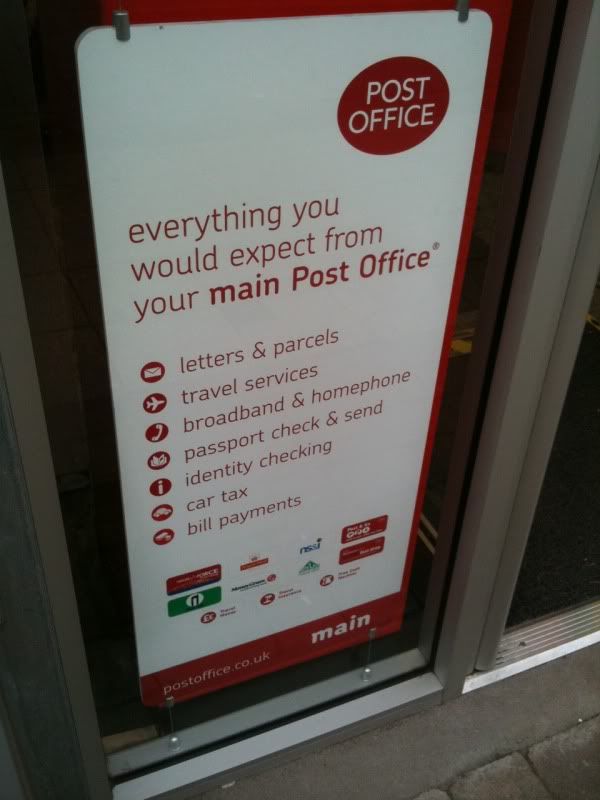
Just noticed there's a Fast Drop and a Post And Go logo on the sign - bizarre considering we have neither

Full-time student, part-time sub Post Office counter clerk.
Can be found tweeting at https://twitter.com/#!/JacksterD
Can be found tweeting at https://twitter.com/#!/JacksterD