Once the nerve centre of a Habsburg empire, Belgium’s postal service helped shape Europe’s first communication network. But in the digital age of emails, NFTs and dwindling letters, Bpost is fighting to stay relevant. From glorious Neo-Gothic post offices to stamps destined for Mars, this is the story of a proud institution struggling to deliver its future.
Not many people stop to read the two bronze plaques on the corner of a Brussels building in the Sablon neighbourhood. One is in French, the other in Dutch. Translated, they read, “Up until 1872, this was the site of the Tour et Tassis Mansion near which François de Tassis established the first international postal service in 1516.”
The greenish plaques are worn with age. Yet you can still make out the features of the young Emperor Charles V with his unmistakable pointed chin on the French plaque, while the Dutch plaque is decorated with a portrait of chubby François de Tassis.
The postal service was initially launched by the Habsburg Emperor Maximilian I to deliver letters from Innsbruck, the seat of the emperor, to Brussels, where the Habsburg governor was based. This postal monopoly was granted to the Italian François de Tassis. Born Francesco Tasso, he came from an aristocratic family known as the Tassos or Tassis. The family later added Taxis to their name, which became Thurn und Taxis when they moved to Germany.
Tour & Taxis
The imperial mail was delivered by a relay of horses that were changed every 28 kilometres. The system grew into a network of postal routes that spread from Brussels across much of Habsburg Europe, linking Germany, Spain, the Low Countries, France and Italy. A letter posted in Brussels would arrive in Innsbruck in precisely five and a half days. A letter to Blois in France took 60 hours to reach its destination, while a message to Rome would be delivered after an exhausting 250 hours on the road.
The Habsburg system might seem quaint compared to email or text messages. But the imperial post marked the emergence of a new communications network. Like the internet today, the postal service made communication faster and more reliable. Its arteries stretched over much of the European mainland, ensuring the sprawling empire could be efficiently managed. It also marked the beginning of Brussels’ ambition to be at the heart of Europe. The city would go on to become a rail hub in the 19th century, a motorway hub in the 20th century, and a political hub in the postwar years. But it began with the mail.
Sadly, Brussels has almost forgotten that it was once the information hub of the 16th century. Most traces of the Tour et Tassis family disappeared after the family moved to Regensburg. The palace overlooking the Sablon church was torn down in the 19th century. It was replaced by the Royal Music Conservatory. Two baroque family chapels inside the Sablon church are the only reminders of the Tour et Taxis connection.
But the city did mark the 500th anniversary of the postal service. In 2016, a small crowd gathered in front of the plaque on the Sablon to mark the event that happened five centuries earlier. The guests included Archduchess Anne Gabrielle of Austria as well as Prince Dimitri della Torre e Tasso, who lives in Brussels. According to his LinkedIn profile, Prince Dimitri co-founded the fashionable Ixelles wine bar Etiquette.
The Tour et Taxis name also survives in the waterfront neighbourhood next to the Brussels canal. It stands on the site of a meadow where, according to some historians, the imperial post horses were put out to graze. The meadow was later turned into a vast industrial site occupied by railway yards, customs warehouses, and a post office.
As you might expect, Belgium has some exceptional post office buildings. Mechelen’s main post office occupies a 12th century building that was once a hostel for pilgrims. It then became the town hall before it was converted into a post office. Outside, an iron sign has the old Dutch word Posterijen, post office. The grandeur continues with an elegant rococo staircase leading into the building. Sadly, the interior is as functional as any other post office.
Architectural gems
Many other impressive post office buildings were built at the end of the 19th century when everyone depended on the postal service to deliver letters, postcards and gifts. The main post office in Ghent is one of the most striking. With its turrets and Gothic windows, it might almost be mistaken for a mediaeval palace. But look carefully and you notice tiny sculptures of carrier pigeons with letters in their beaks.
There was once a fascinating Post Museum on the Sablon that focused on the story of the postal service. But the museum closed. And then the country’s post offices, one by one, were shuttered.
The internet has made a huge dent in the post office’s revenue. People now send emails rather than letters. They post photos on social media rather than sitting down to write a postcard. And the government sends out invoices by email rather than using the post. As a result, the volume of mail has dropped dramatically over the past two decades.
Almost every historic post office building in Belgium has been sold off to developers. The main post office in Ghent has been converted into a shopping centre with a luxury hotel nestled in the upper floors. The modernist post office Ostend has also gone. Designed in 1953 by Gaston Eysselinck, the post office was an impressive building where tourists once queued up to send postcards or use payphones to call distant relatives. The airy building is now a cultural centre called De Grote Post. All that remains of its original function, apart from the name, is a row of wooden phone boxes in the café now used to frame giant photos of Flemish writers and artists.
The Grand-Poste in Liege is a magnificent Neo-Gothic building on the Meuse waterfront designed by Edmond Jamar. It closed down in 2002 and stood empty for the next 14 years while various plans were proposed and subsequently rejected. Finally, the building was renovated to create a co-working space with a food hall and rooftop bar.
Other post offices have been left to rot. The modernist post office in Ixelles commune closed down some years ago. There was talk of converting it into a museum, or affordable housing, or maybe an extension to the architecture school next door. But despite its prime location behind Place Flagey, the building remains empty and covered in graffiti.
The future now looks bleak for post offices all over the world. In March, Denmark’s state-run postal service PostNord announced that it would end all letter deliveries at the end of 2025. Beginning in the summer, the company will remove all 1,500 Danish letter boxes. And it will also phase out postage stamps.
Stamp collecting
The situation in Belgium is not so dire. You can still find a local shop or supermarket with a Bpost counter. And the Belgian postal office continues to deliver letters and issues colourful stamps.
The first Belgian stamps were issued in 1849 with the head of Leopold I and the country named in French. For more than 150 years, the stamps have been printed at a production plant in Mechelen. It’s now one of the last printing facilities of its kind in Europe, with more than one hundred million stamps rolling off the presses every year. As well as Belgian stamps, the production line produces stamps for Luxembourg, Portugal, Austria, Gibraltar and the Vatican.
The printing works known as Het Zegel (The Stamp) moved into an abandoned candle factory on Mechelen’s Vaartdijk in 1868. The canal side site lay close to Mechelen’s main station, which formed the main hub of the country’s dense rail network. It meant new stamps could be sent rapidly by train to every corner of Belgium.
The printing works finally closed down in 1993. For the next 30 years, the landmark brick building was left to rot. The decayed interior became a popular destination for urban explorers until the building was finally acquired by a project developer to create an office and apartment complex.
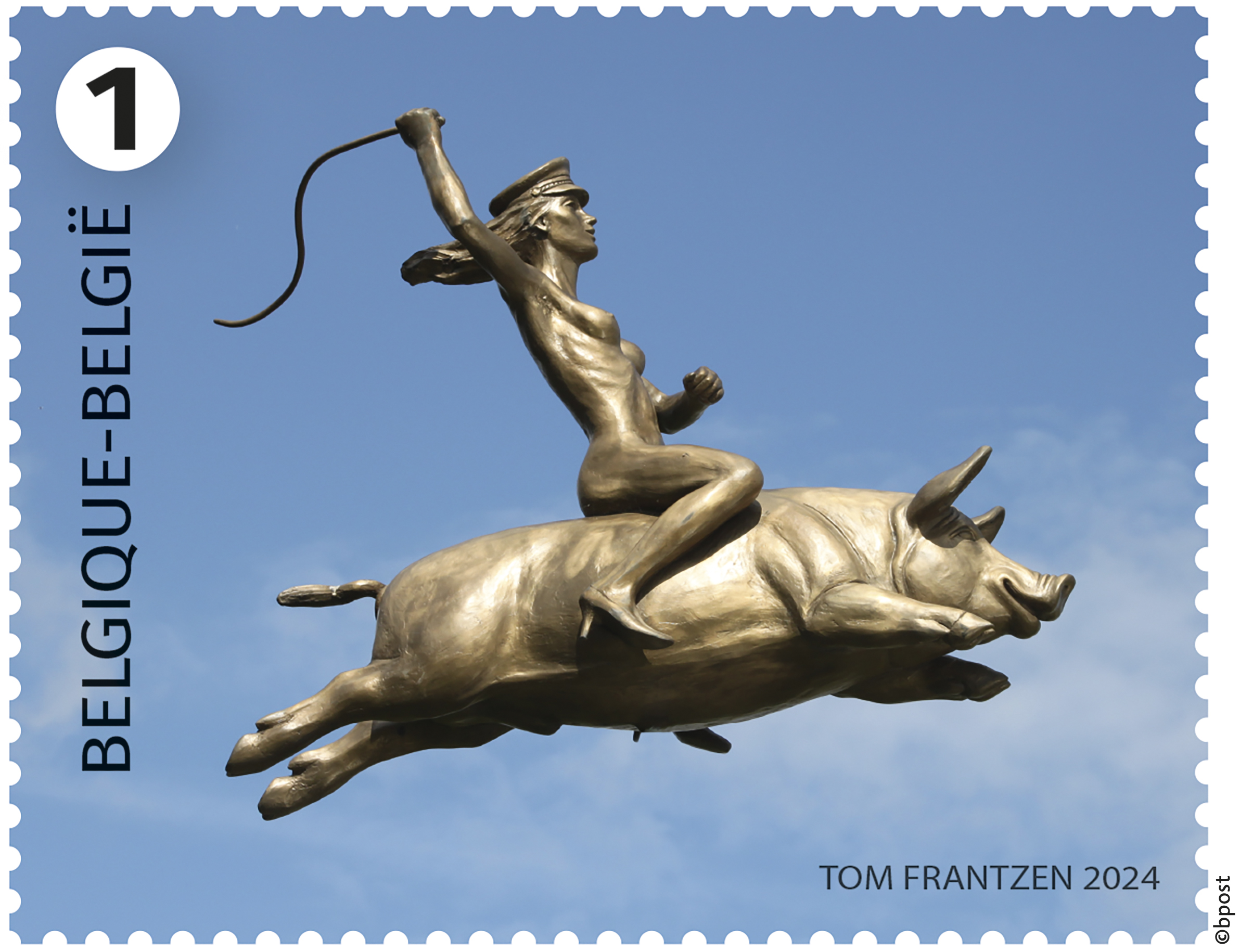
Special Bpost stamp by Belgian sculptor Tom Frantzen
The passion for collecting postage stamps looks like it won’t survive. The Rue du Midi in Brussels was once dotted with dealers who sold exotic stamps from distant countries, along with vintage postcards sent a century ago. But hardly any of the dark little shops have survived. The philately clubs that once flourished all over Belgium are struggling to find younger members.
Yet Belgium continues to issue new stamps. These limited editions are not sold in post offices, but they can be ordered online. This year sees the issue of a stamp commemorating 600 years of Leuven University, along with a stamp illustrated with cartoon Smurfs promoting the United Nations sustainable development goals. There’s even a stamp coming out later this year to celebrate the number pi.
Other recent themes include Belgian bandstands, the country’s choreographers and the buildings of Hasselt. Meanwhile, Belgium’s weird surrealism is expressed by a limited-edition stamp illustrating a Tom Frantzen sculpture featuring a woman wearing only riding boots and a hat riding a flying pig.
Cats & crypto
Determined to shake off its stuffy image, Bpost recently launched a cryptocurrency stamp that combined a physical postage stamp with a collectable NFT that only exists as a digital token. It has also issued stamps that glow in the dark, a stamp dedicated to underwater species that is printed with a varnish that makes it seem that fish are swimming, and a 2024 stamp to celebrate the 150th anniversary of the Universal Postal Union that includes 2,024 words (a world record).
Bpost might also be one step closer to a daily delivery to Mars. It has issued a series of stamps celebrating Belgian contributions to space exploration printed with the tariff region ‘Universe,’ to add to the existing three rates of Belgium, Europe and World.
There’s one topic that Bpost still hasn’t celebrated. “For a brief period, cats delivered mail in Belgium,” according to a recent post on X that went viral. “During the 1870s, the city of Liège ‘hired’ 37 cats to deliver mail in waterproof bags. As expected, the cats weren’t effective mailmen.”
The story relied on a long-forgotten article published in 1876 in the New York Times by the writer William L. Alden. The author claimed the cats were being trained to replace Belgium’s carrier pigeons. It was picked up and widely circulated on internet sites. But the Belgian broadcaster RTBF recently investigated the story and pronounced it an urban myth. The broadcaster went on to explain that cats were sometimes set loose in post offices to catch mice that might chew the mail.
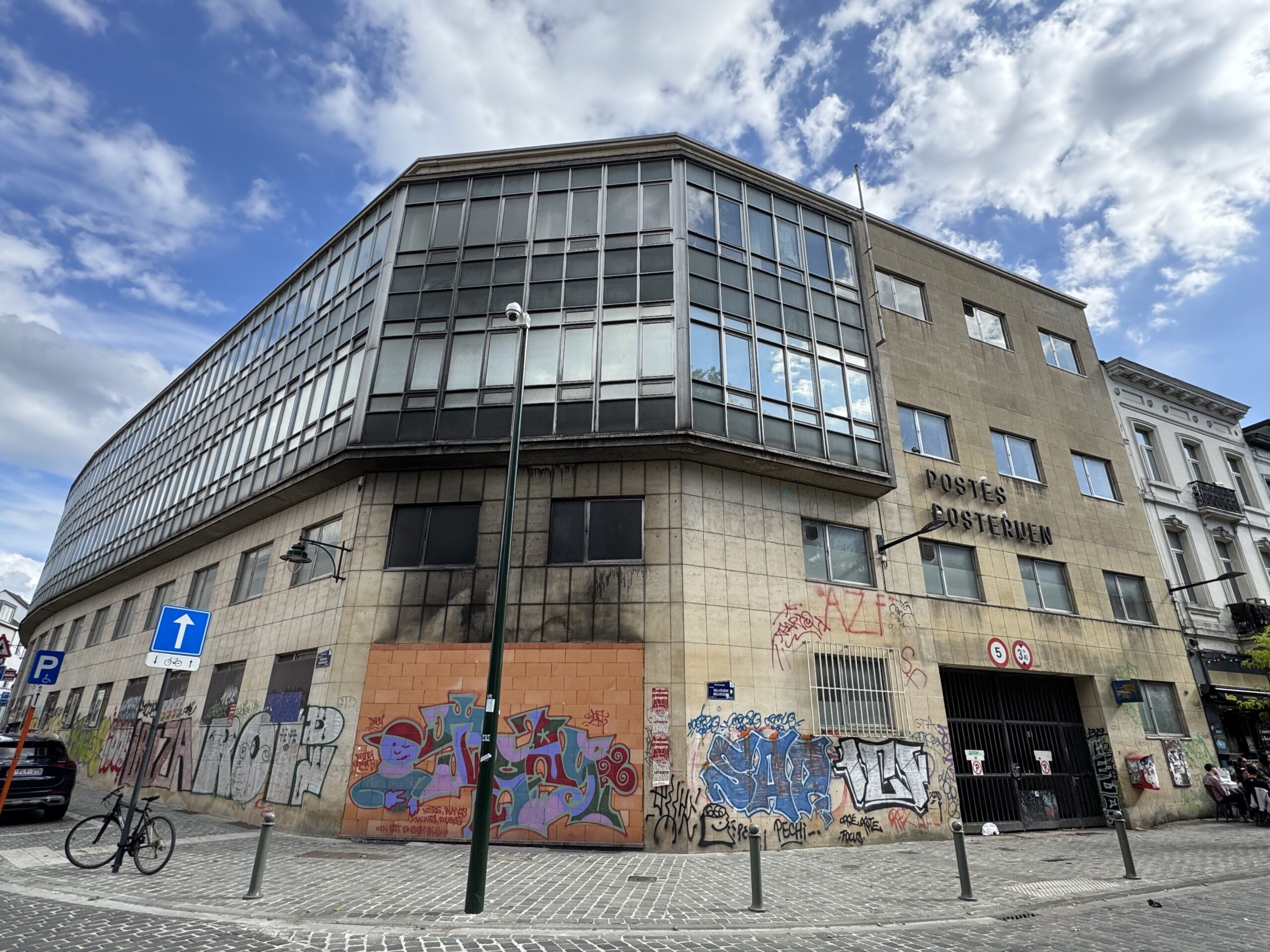
The abandoned post office in Ixelles
For all its rich history and innovative stamps, the Belgian postal service is struggling to survive. It has seen a massive drop in letters sent, along with stiff competition from competing parcel delivery services. In a bid to remain relevant, Bpost has invested massively in parcel lockers where customers can drop off and pick up parcels. It has already established 3,000 pick-up points with a further 1,000 planned.
The semi-privatised company with a turnover of €4.4 billion is still in deep trouble. Earlier this year, the share price slumped by 60 percent, leading to comments that a Bpost share is now worth less than a postage stamp. The dramatic drop was caused in part by Bpost losing a lucrative contract to deliver newspapers worth €167 million, along with a bloated workforce, and a series of strikes in sorting centres across Brussels and Wallonia. “I was ready for a marathon when I started this job,” declared Bpost CEO Chris Peeters, “But I’m suddenly having to do it with a rucksack filled with ten kilos of rocks.”
The Belgian post office likes to believe it might one day deliver mail to Mars. But maybe it’s more likely that Belgium will follow Denmark and close down its postal service. If so, it would be the end of a rich history that began more than five centuries ago in the heart of Brussels.