
Three weeks ago, iSIGHT Partners discovered a new Ransomware encrypting victims’ documents. They dubbed this new threat TorrentLocker. TorrentLocker propagates via spam messages containing a link to a phishing page where the user is asked to download and execute “package tracking information”. In August, only Australians were targeted with fake Australian Post package-tracking page.
While tracking this new threat, ESET researchers found the malicious gang is targeting new victims. Internet users from the United Kingdom should be aware that fake Royal Mail package-tracking pages are online and distributing TorrentLocker.

Royal Mail phishing page
The scheme is the same: you type a captcha then click to download a zip file containing the executable payload. It is interesting to note that the fake Royal Mail page will only show if the visitor is from the UK. Filtering seems to be based on the IP address of the request. If the request does not come from a UK IP address, the victim will be redirected to google.com. Three new domains are hosting the fake Royal Mail page:
royalmail-tracking.info
royalmail-tracking.biz
royalmail-tracking.org

oyalmail-tracking.info registration information
As you can see, registration date for these domains is September 2nd so this campaign started very recently.

 Encrypted files in users’ pictures
Warning is shown upon execution of the malware
Once installed, victims’ documents are encrypted and they are being asked for a ransom of 350 £ if paid within 72 hours or 700 GPB otherwise. Payment is done via Bitcoin transaction (1.19 BTC or 2.38 BTC). To hide their infrastructure, the web server is hosted on a .onion host on the Tor network.
To make it is easy for victims to access the web page, TorrentLocker is giving links to Tor2Web nodes so they don’t have to install additional software to reach the .onion website. Interestingly, door2tor.org, the domain name of one of the suggested Tor2Web node, was registered only 2 weeks ago. Perhaps its purpose is only to allow TorrrentLocker’s victims to contact the server selling the decryption software.
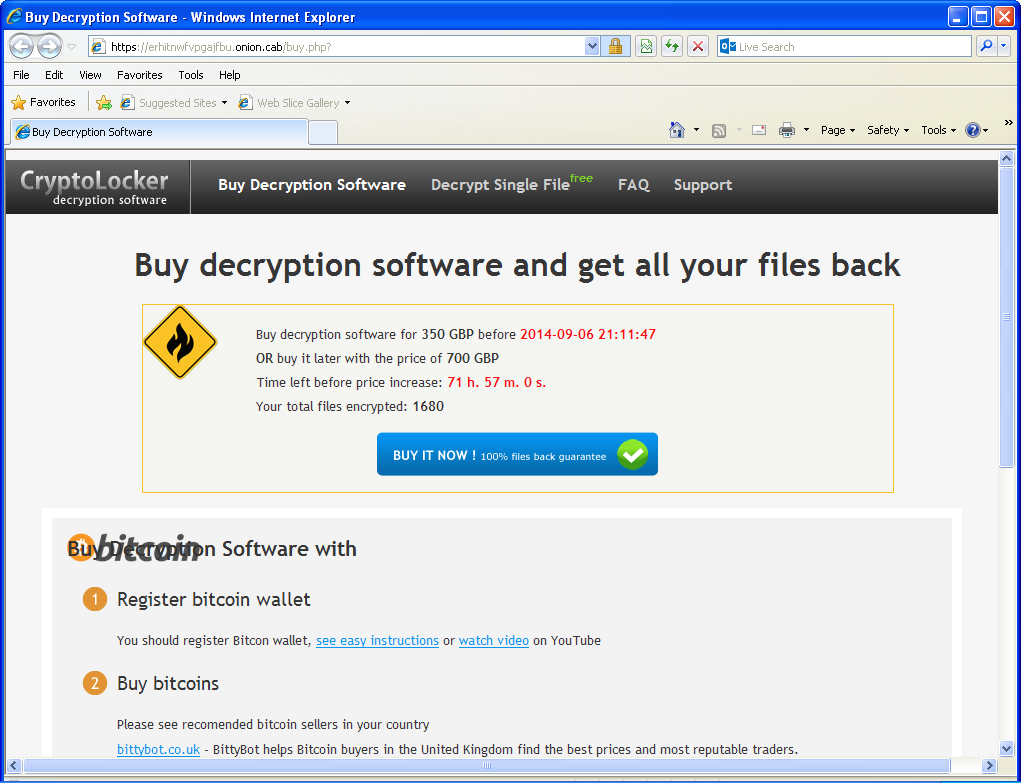
“Decryption software” sold on the Tor network
This threat caries the TorrentLocker name because it use the “Bit Torrent Application” Windows registry key to store its settings. It is unrelated to the BitTorrent protocol.